Выпуск
Satellite Connectivity may be Coming Soon to a Mobile Device Near You
The Journal of Space Commerce Podcast · 14 сентября 2025 г. · 12 мин
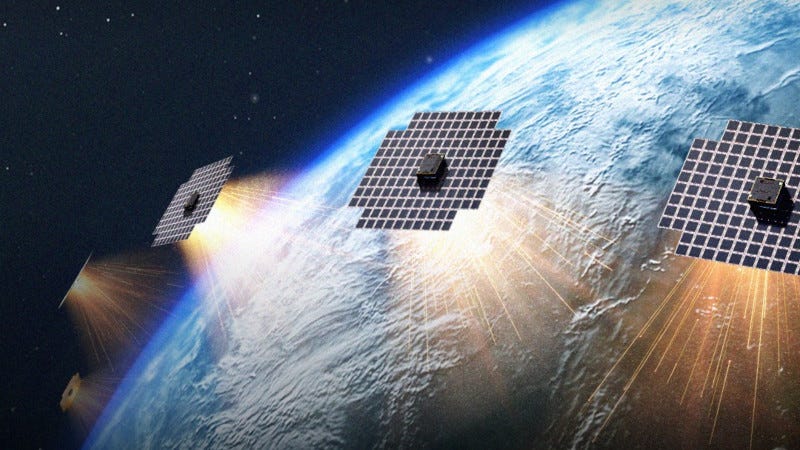
Federal regulators accepted applications that would enable satellites to provide cellular coverage directly to existing smartphones in partnership with major wireless carriers. The FCC announced last week that AST SpaceMobile and AT&T, Verizon, and FirstNet have filed joint applications for supplemental coverage from space authorization. The Space Bureau, Wireless Telecommunications Bureau, and Public Safety and Homeland Security Bureau found the applications acceptable for filing after initial review. AST SpaceMobile seeks authority to operate 248 non-geostationary orbit satellites that would work with terrestrial networks from AT&T, Verizon, and FirstNet, and would use existing cellular frequency bands for the service. The company filed applications to modify its existing satellite authorization on June 12, with amendments submitted July 21 and Sept. 3. The applications require multiple waivers of current FCC rules. The companies seek waivers to deploy supplemental coverage in areas where terrestrial carriers don't hold spectrum across entire geographic service areas. They also request permission to provide service on devices certified before June 29, 2024, that lack specific authorization for satellite operations. Under existing rules, satellite operators and wireless licensees can enter spectrum leases only when holding all co-channel licenses throughout one of six geographic service areas. AST SpaceMobile, AT&T, and Verizon argue their cellular licenses don't cover entire continental U.S. areas, necessitating rule waivers. -0- The satellite payload market is projected to be nearly 11 and a half billion dollars in 2030, up from just over 6 billion in 2025 ($11.44 billion in 2030 from $6.07 billion in 2025) at a CAGR of 13.5% during the forecast period according to a new report from MarketsandMarkets . The growth is mainly due to the expansion of sovereign and regional mega constellations for strategic and commercial communications, international strategic collaborations, and flagship Earth observation missions. The market is witnessing strong growth globally, fueled by the rising international partnerships and collaborations for Earth Observation applications across different regions, and the rising number of satellite constellation launches for mega constellation projects. Further, the growth of the satellite payload market is attributed to the demand for high-speed internet and telecommunication services, along with the need for better management of Earth Observation satellite missions. The LEO segment is expected to register the highest CAGR in the market during the forecast period. As operators and governments compete to secure space-based connectivity and Earth observation capabilities, the global satellite payload market is changing due to the increasing demand for payloads from Low Earth Orbit (LEO) constellations. In recent years, there has been an unprecedented demand for satellite payloads that are lighter, more modular, and more mass-producible due to mega-consortia like SpaceX's Starlink, OneWeb, and Amazon's Kuiper. There will be a sustained need for payloads in the areas of scientific research, communications, and imaging, as evidenced by the fact that Starlink alone required more than 6,000 operational satellites in 2024 and is expected to launch new batches at an unprecedented rate. The large satellite segment is projected to dominate the satellite payload market share in 2025, primarily due to its high cost of payloads compared to that of small & medium satellites. Europe is projected to account for the second-largest market share because of the presence of some of the major satellite payload manufacturers, including A