Выпуск
Novel Mission Licensing Rules, and a Spectrum Auction That Will Benefit Satellite Companies
The Journal of Space Commerce Podcast · 2 августа 2026 г. · 14 мин
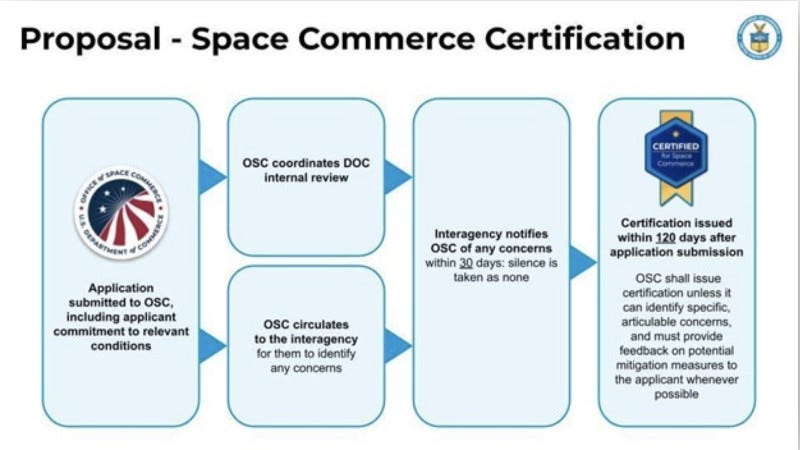
The Office of Space Commerce says it will publish a Federal Register notice within weeks seeking the first applications for its proposed space licensing certification . The notice would invite companies to apply under the “Space Commerce Certification,” a voluntary process OSC proposed in March to consolidate licensing for commercial space activities not clearly covered under existing FAA, FCC or OSC remote-sensing rules. The office says it plans to begin certifying missions within months of the notice’s publication. OSC posted a video with the announcement. Commerce Secretary Howard Lutnick framed the certification as central to the department’s ambitions in space. “It’s going to be a multi-trillion dollar industry, and the Department of Commerce is going to lead the way.” he said, adding that the certification carries what he called a presumption of approval. “Which means we’re looking to help you get in business, to get in space, to launch your satellites, and to create the amazing opportunity that’s going to be space.” The announcement comes eight days after OSC Director Taylor Jordan testified before the House Science, Space, and Technology Committee’s Space and Aeronautics Subcommittee. Lawmakers there questioned whether the office has the money to run the process it’s now moving to launch. The Trump administration’s fiscal 2027 budget request seeks $11 million for OSC, down from an enacted 52-and-a-half million this year. Jordan told the subcommittee the office hasn’t built additional staffing into its budget for the certification work. The FAA, FCC, and OSC’s own remote sensing division have not said whether they’ll accept the certification in place of their existing requirements. That means companies who apply before that question is settled may not know yet how much regulatory relief the certification will actually deliver. OSC has not said which category of activity — satellite servicing, in-space manufacturing, or lunar operations — will be first in line once the Federal Register notice publishes. -0- The FCC has approved a framework to free up 160 megahertz of Upper C-band spectrum for wireless use across the country. The Commission adopted the order Wednesday under two dockets, combining freshly cleared spectrum between 3.98 and 4.14 gigahertz — plus a 20 megahertz guard band — with previously auctioned Lower C-band frequencies. Together, that creates a contiguous 440 megahertz band for next-generation wireless service. The move satisfies a requirement in the One Big Beautiful Bill Act that the commission auction at least 100 megahertz of the band by July 4, 2027. Three satellite operators will split $6.3 billion in incentive payments for clearing the spectrum: SES gets a touch over $5.6 billion, Eutelsat gets $504 million, and Telesat gets $189 million. The payments come in two installments — $4.914 billion tied to a primary deadline, followed by $1.386 billion before a second deadline. Operators who fall more than 180 days behind schedule forfeit the payment entirely. New Upper C-band license holders will also have to reimburse the operators’ transition costs, which the commission estimates at $4 to $5 billion. Commissioner Anna Gomez approved the order in part but dissented on one point — she wanted a Tribal Licensing Window added for the Navajo Nation, the Shoshone-Bannock Tribes and other tribal governments. “As part of the federal government, the FCC has a trust responsibility to tribal nations. The United States trust responsibility to tribes is a legal obligation established by the Constitution, treaties, and over a hundred years of Supreme Court precedent. Under this obligation, we engage with tribal nations o