Выпуск
Starship achieves orbit, and an Update on Starliner
The Journal of Space Commerce Podcast · 4 октября 2026 г. · 16 мин
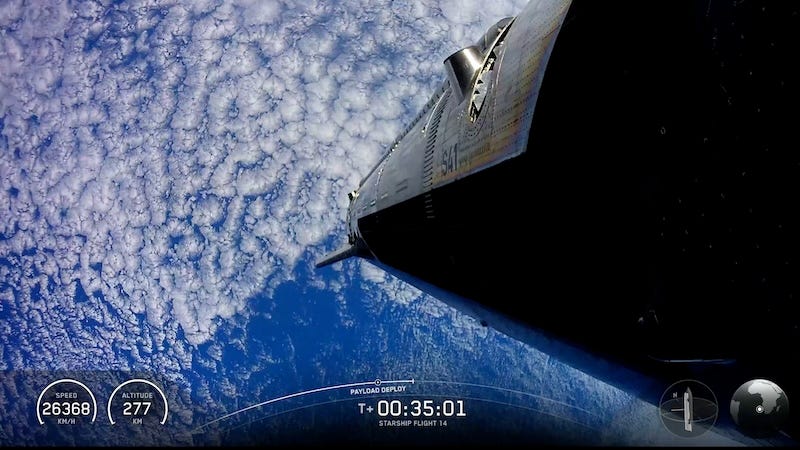
A SpaceX Starship reached orbit on Test Flight 14 , marking a significant milestone towards NASAs goal of building an ongoing human presence on the moon. Starship lifted off as its launch window opened at 7:48 am local time at Starbase Texas. The super heavy booster performed mostly nominally, though one of the 33 Raptor engines did shut down prematurely. Still, the mission continued with a clean stage separation and booster return to Earth, splashing down in the Gulf of America about 8 minutes after launch. The booster simulated the manuver that will be needed for a capture back at Starbase, but it did not attempt that land recovery on this mission. There were more tense moments when one of the two Raptor Vac engines on Ship failed during the initial ascent. But the SpaceX team determined that since the sea level engines were all that were needed for orbital insertion and de-orbit burn, the mission could continue. Through the Starlink relay, SpaceX was able to provide spectacular images of Earth and the spacecraft in orbit while a batch of 28 operational Starlink V3 satellites were deployed. Ship did not complete the planned six orbits of the Earth. The de-orbit burn was initiated after just one full orbit, with splashdown occurring in the northern Pacific Ocean. The mission was cut short after mission controllers determined that all objectives had been accomplished and they had collected all pertinent data. With this orbital milestone achieved, SpaceX and NASA can start looking ahead to testing the in-orbit docking and refueling capability that will be necessary for the return to the lunar surface. Executive Order 14369 signed by President Trump last December directed NASA to land humans back on the Moon by 2028, with a permanent human presence established by 2030. -0- NASA and Boeing held a news conference Monday to provide an update on the Starliner program. Boeing was awarded a commercial crew contract to provide transportation to and from the International Space Station in 2014. Three test flights were completed, one manned, that took Butch Wilmore and Suni Williams to the ISS ... but ongoing issues with multiple systems forced NASA to bring the Starliner spacecraft back to Earth without its crew. Wilmore and Williams spend nearly nine months aboard the station, and eventually returned to Earth aboard a SpaceX Crew Dragon capsule. In June, the NASA Office of Inspector General issued a report that said Starliner would be at least a decade behind schedule. In the meantime, the agency has shifted several crew rotation flights over to SpaceX, which is currently the sole U.S. provider of transportation services to the station. During the news conference, NASA Administrator Jared Issacman said Starliner is still critical for assuring reliable continued access to ISS. “So given our extensive history with Starliner and the taxpayer investment already made, we believe it represents the fastest path to preserving reliable crewed access to low Earth orbit. But from the beginning, commercial crew was built around competition, and NASA continues to see real value in having two crew transportation providers,” Issacman said. “Our forecasted demand is approximately 1 crewed mission to low Earth orbit every six months, and competition can help drive down costs, strengthen resilience, and support the broader commercial ecosystem.” Isaacman noted SpaceX plans to retire Falcon 9 and Dragon as it transitions to Starship, which reached orbit the same day as the briefing. He said NASA wants a second ride. John Mulholland, Boeing’s Starliner Program Manager, said the uncrewed flight is on track for the December–January timeframe, lined up with