Выпуск
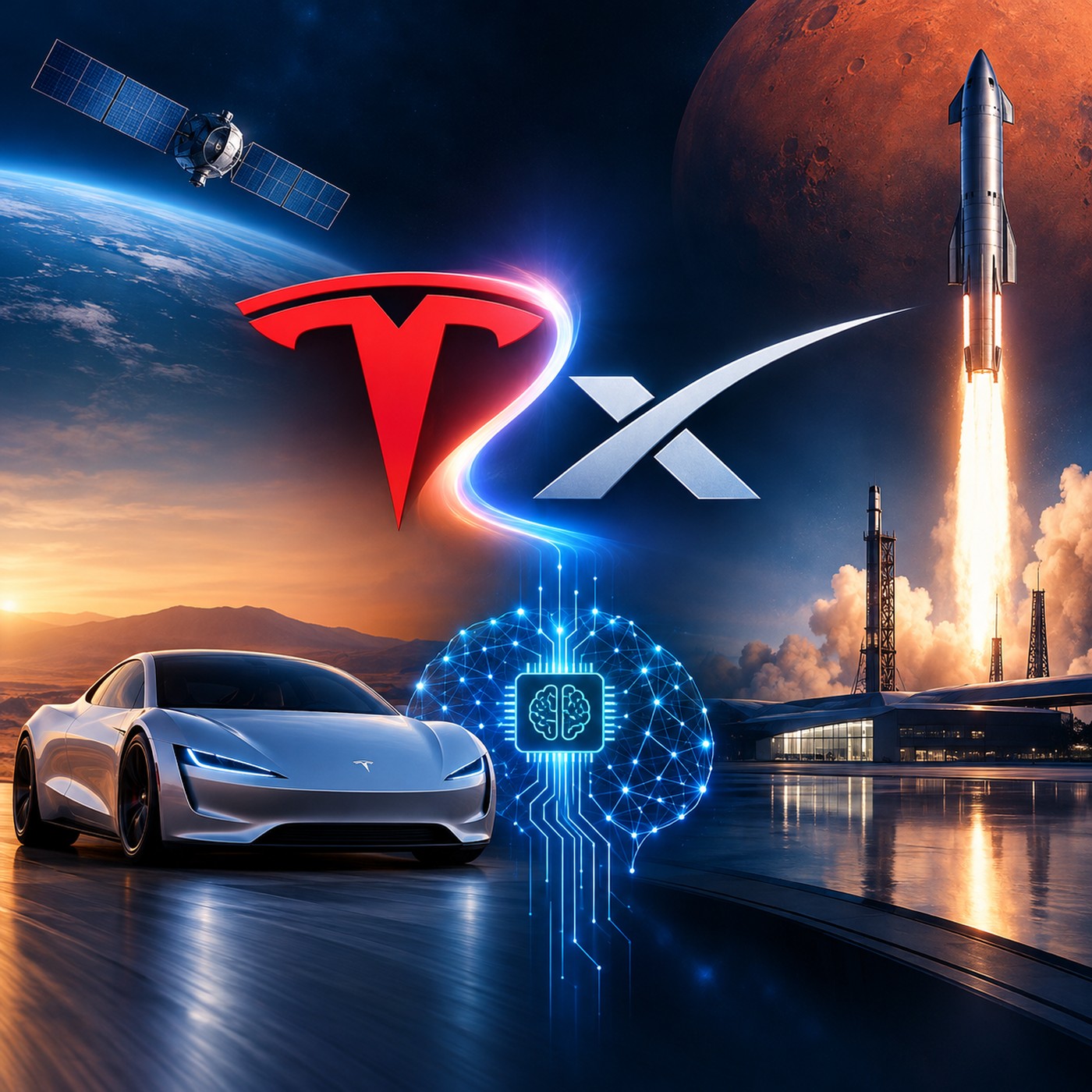
Episode #113: The Infinite Slop Cannon in the Sky: How Elon's Building His Empire
Stewart Squared · 29 октября 2026 г. · 57 мин
In this episode of the Stewart Squared podcast, host Stewart Alsop and his son Stewart Alsop II explore the convergence of autonomous robotics, corporate consolidation, and network infrastructure. The conversation kicks off with speculation about a potential Tesla-SpaceX merger, drawing parallels to Japanese keiretsus and examining how Elon Musk might be building what they dub "Musk X"—a unified empire spanning rockets, AI, autonomous vehicles, and satellite networks. From there, they venture into the world of dog bots and robotic operating systems, with Stewart II demonstrating real-time AI-generated web content and discussing his plans to build mesh networks for dance-battling robots. The elder Alsop brings decades of venture capital perspective to bear on topics ranging from Amazon's distribution superiority over Walmart to Salesforce's bold pivot toward agent-based pricing, while they both grapple with fundamental questions about what constitutes an operating system in an age where the boundaries between physical robots, digital networks, and creative tools are rapidly dissolving. Key Insights Here are seven key insights from this episode: 1. Elon Musk appears to be consolidating his various companies into what could be called a modern American keiretsu, similar to the Japanese and Korean conglomerates that organized multiple industries under unified control. The recent Tesla Roadster demo featuring SpaceX thrusters signals a potential merger between Tesla and SpaceX. This consolidation strategy would create an integrated empire spanning rockets, satellites, AI, solar energy, tunneling, and automotive technologies. Musk seems to be moving toward a single company structure that allows investors to bet on him personally rather than individual business units, though the complexity makes it difficult for analysts to properly value the combined entity. 2. The concept of operating systems is evolving beyond traditional definitions as technology moves into robotics and autonomous systems. Historically, operating systems were tied to specific hardware architectures with CPUs and memory, but now the term is being applied loosely to networks and platforms. For robots and autonomous vehicles, operating systems must manage both local hardware and network connectivity simultaneously. Companies like Amazon have developed fleet level coordination systems that function as operating systems for managing thousands of warehouse robots, while Tesla and Waymo have built proprietary systems for their vehicles. The emergence of robotic operating systems represents a fundamental shift in how we think about computing infrastructure. 3. Amazon has successfully built a purpose designed distribution system that competitors like Walmart struggle to match because Amazon anticipated future needs rather than modifying existing infrastructure. Amazon created an ontology that modeled people, warehouses, and distribution centers as an integrated system from the beginning. Walmart faces difficulties because their distribution system was originally designed to serve stores rather than individual consumers. This demonstrates how companies that build systems with future scalability in mind gain significant competitive advantages. Amazon's ability to deliver products next day even in smaller cities like Santa Fe illustrates the power of this forward thinking approach. 4. The economic models for AI companies remain unclear and unstable, with Character AI becoming potentially the first major AI casualty by filing for bankruptcy despite user engagement. Many companies that built applications on top of foundation models are now struggling as those foundation models absorb market value. Salesforce represents an interesting case study as CEO Marc Benioff pivots the entire business model from traditional SaaS subscriptions to charging for AI agent usage and token consumption. This willingness to abandon