Выпуск
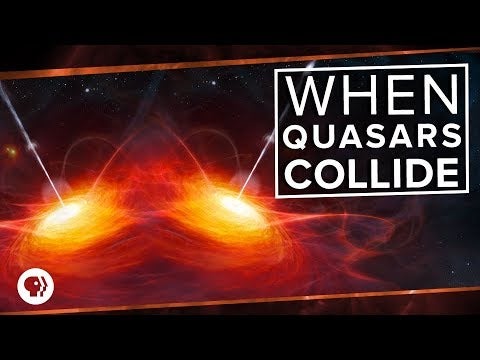
When Quasars Collide STJC
PBS Space Time · 19 ноября 2026 г. · 17 мин
Viewers like you help make PBS (Thank you 😃) . Support your local PBS Member Station here: https://to.pbs.org/DonateSPACE Uploaded 04-10-17 So what happens when two Super Massive Black Holes collide? We may be about to find out, because astronomers have spotted a pair of them in a close binary orbit for the very first time. This episode of Space Time Journal Club discusses: "A candidate sub-parsec binary black hole in the Seyfert galaxy NGC 7674", Kharb, Lal and Merritt 2017 https://arxiv.org/abs/1709.06258 You can further support us on Patreon at https://www.patreon.com/pbsspacetime Get your own Space Time tshirt at http://bit.ly/1QlzoBi Tweet at us! @pbsspacetime Facebook: facebook.com/pbsspacetime Email us! pbsspacetime [at] gmail [dot] com Comment on Reddit: http://www.reddit.com/r/pbsspacetime Help translate our videos! https://www.youtube.com/timedtext_cs_panel?tab=2&c=UC7_gcs09iThXybpVgjHZ_7g Previous Episode: Are the Fundamental Constants changing? https://www.youtube.com/watch?v=YJzoelANL_Y&t=8s Related Episodes: How to Build a Black Hole https://www.youtube.com/watch?v=xx4562gesw0 Why Quasars are so Awesome https://www.youtube.com/watch?v=3TZEp_n3eIc Links to Comments Response: Nevermind https://www.youtube.com/watch?v=YJzoelANL_Y&lc=z223hpipuozhh1qbj04t1aokgn5pfpqlq0zgbnrilm5obk0h00410 Lutra Nereis https://www.youtube.com/watch?v=YJzoelANL_Y&lc=z22cwtzjvv3ojx0ucacdp430ixcyhmpsu1ahlosnyedw03c010c Arnaldo Castro https://www.youtube.com/watch?v=YJzoelANL_Y&lc=z22txnyo1lnwh1j03acdp430bunzm5m4x3xf5jwx0xxw03c010c 0xFFF1 https://www.youtube.com/watch?v=YJzoelANL_Y&lc=z23sjnwjrwnljxe3macdp434i1lxdqjdsvf2ovd3r41w03c010c WispXLegend https://www.youtube.com/watch?v=YJzoelANL_Y&lc=z22rivtz4oz2db4kmacdp431v2mactt0223icalvag1w03c010c Rubbergnome https://www.youtube.com/watch?v=YJzoelANL_Y&lc=z22phdvhwsyehtjxe04t1aokg3gkri0vdluvsttfuju0bk0h00410 In this video, we discuss the reports about the detection of a pair of supermassive black holes orbiting only one light year apart from each other. Studying the dance of these giants should tell us a ton about how black holes grow. This paper was just published in Nature Astronomy by Preeti Kharb and Dharam Vir Lal from India’s National Center for Radio Astrophysics, and David Merritt from the Rochester Institute of Technology. Written and Hosted by Matt O'Dowd Produced by Rusty Ward Graphics by Kurt Ross Assistant Editing and Sound Design by Mike Petrow Made by Kornhaber Brown (www.kornhaberbrown.com) Special thanks to our Patreon Big Bang, Quasar and Hypernova Supporters: Big Bang BITISM CoolAsCats David Nicklas Ric