Выпуск
Stanford Seminar - SMILE: Synchronized, Multi-sensory Integrated Learning Environment
Stanford Online: University Courses & Lectures · 19 ноября 2026 г. · 1 ч 20 мин
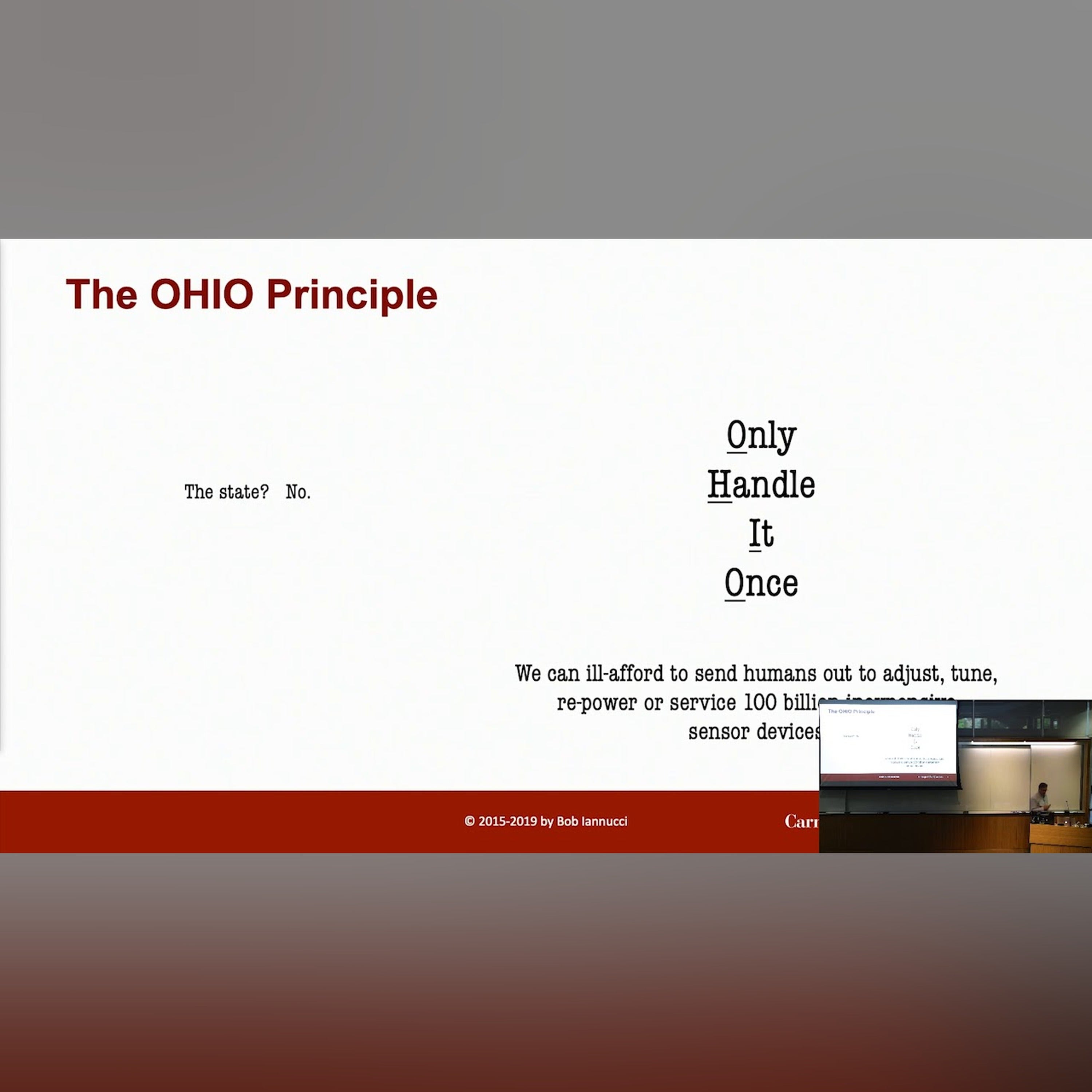
Robert Iannucci Carnegie Mellon University Director, Cylab Mobility Research Center May 29, 2019 Wirelessly-enabled sensing technologies offer the hope of enabling economically and socially important applications including intelligent transportation systems and other so-called smart city initiatives, home automation, improvements in manufacturing, and tools for humanitarian assistance and disaster response. Importantly, the value may only be realizable through the integration of a number of dis-similar, separately-built, separately-owned, and separately-controlled sensing sub-systems. SMILE -- the Synchronized Multi-sensory Integrated Learning Environment -- is a CMU project that aims to create, deploy and validate a framework that addresses key challenges that arise in such a system-of-systems. Uploaded 05-06-19 In this talk, we present early results of the SMILE project. We begin with an examination of some practical barriers in a typical smart city application. From this, we develop themes related to low-power operation, programmability, synchronization, federation, and the interplay between them. Within this context, we discuss four sub-projects: (1) a synchronization approach for low-power devices, (2) a family of visual sensing techniques that explore the domain of real-time learning onboard small unmanned aerial systems (sUAS), (3) a demonstration system that combines information from such sUAS with intelligent ground-based sensors, and (4) the sketch of a new language framework, called TickTalk, that seeks to ease the programmer's burden in creating software for such complex, heterogeneous, distributed, fault-prone systems. View the full playlist: https://www.youtube.com/playlist?list=PLoROMvodv4rMWw6rRoeSpkiseTHzWj6vu 0:00 Introduction 1:53 Observations 6:18 Adoption Depends on Behaviors and Habits 7:19 Some Implicit Criteria for Success 12:16 Corollaries to the OHIO Principle 17:21 An Hour in the Life of an OHIO Device Designed for a Five-year Mission 19:33 Application-Specific Time Accuracy Requirements 21:42 The Value is in Sharing Data 22:04 Programing Today's Distributed System 23:17 Programming in the Cyber-Physical Network 24:06 A Perspective on our Challenges 25:58 Platformization and lannucci's Law 26:44 Computing Platforms: Past and Present 35:27 Hypothesis: it will be the The Cyber-Physical Network 36:14 Design Parameters of this New Computing Platform 39:30 CCSG: Integrating Computing and Communications 41:07 Projects 41:39 LongShot: Long-Range Synchronization of Time 43:13 Main Challenges 47:03 How accurately can we timestamp? 47:38 Semtech SX1276 Timing Characterization - Transmit 48:40 Approach 48:43 Two-Step Synchronization Result 3 Devices over a 2 hour period @ 4km 50:19 PowerDue: Power / Energy Aware Programming 55:26 Synchronized Multisensory Learning 55:54 ClickBAIT: Click-Based Accelerated Incremental Training 59:04 Results: Classification Learn more about your ad choices. Visit megaphone.fm/adchoices